My station
Station & equipment
My radio station consists of a fixed home operating position, an external UHF antenna and test equipment for monitoring the performance of the system.
Overview
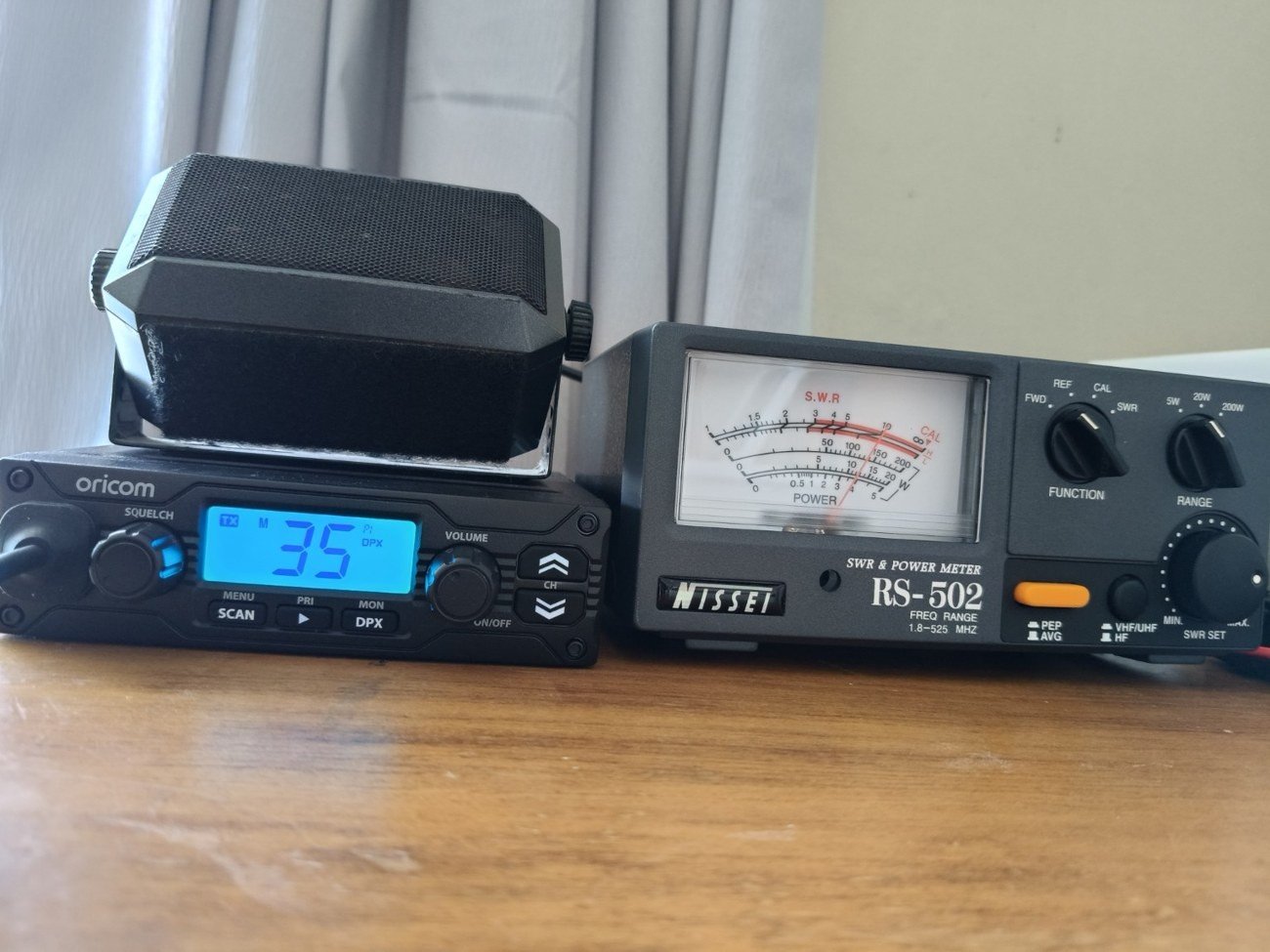
My complete UHF CB base station
My Oricom is designed as a mobile radio but is used at home as a permanent base station. A base station is simply a two-way radio installed at a fixed location. This allows me to operate from my desk rather than using a handheld radio or operating from a vehicle.
| Equipment | Details |
|---|---|
| Radio | Oricom 80-channel UHF CB/PRS |
| Operating frequencies | New Zealand 477 MHz UHF CB band |
| Transmitter power | Approximately 4 watts measured |
| RF power meter | Nissei RS-502 |
| Antenna | Techoman 6.5 dBi vertical |
| Coaxial cable | 10 metres of RG213 |
| Antenna test instrument | SV4401A Vector Network Analyzer |
| Measured antenna SWR | 1.17:1 at 477.240 MHz |
| Communication | Simplex and repeater operation |
How my equipment connects
Radio signals are then transmitted into the surrounding area. Each component has a specific purpose, explained below.
The transceiver
My Oricom UHF CB radio
The heart of the station is my Oricom UHF CB radio. It operates on New Zealand’s UHF Personal Radio Service (PRS), commonly known as UHF CB radio. UHF stands for Ultra High Frequency.
The radio operates in the 477 MHz frequency band, where radio signals can be used for local direct communication and communication through repeaters.
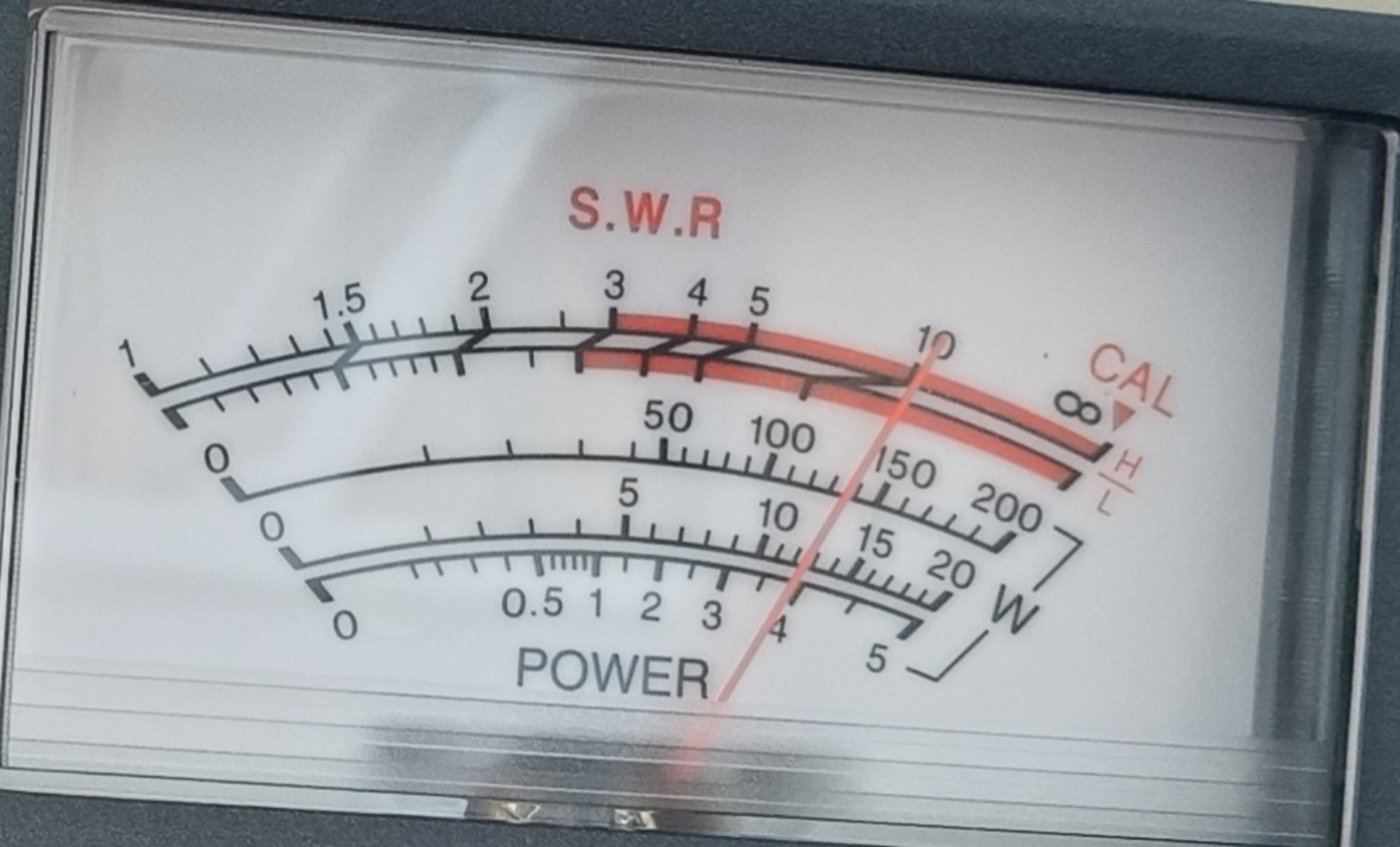
My radio has a nominal maximum transmitting power of 5 watts. However, when measured using my Nissei RS-502 power meter, it indicates approximately 4 watts of forward RF power. This is quite suitable for my installation. The difference between 4 watts and 5 watts is only approximately 1 dB, so increasing the power by that small amount would generally produce little noticeable improvement. For UHF communication, antenna height, cable loss, antenna performance and terrain can be far more important.
When I press the microphone’s push-to-talk button, the transmitter sends my voice through the antenna as radio waves. When I release the button, the radio returns to receive mode, allowing me to listen to other stations. Two-way radio communication is normally conducted one person at a time. This is called simplex-style push-to-talk communication, even when the conversation is taking place through a repeater.
Why my radio measures 4 watts instead of the advertised 5 watts
When I purchased my Oricom UHF CB radio, the packaging advertised a nominal 5-watt transmitter output. My own Nissei RS-502 meter indicates approximately 4 watts of forward power while transmitting (on the 5-watt scale, subject to the correct meter settings). Although I would naturally prefer the radio to deliver the advertised 5 watts, that difference is quite small in everyday radio communication.
Nominal output on the packaging.
Forward power on my Nissei RS-502.
10 × log₁₀(5 ÷ 4) = 0.97 dB.
Understanding the difference in decibels (dB)
Radio signal changes are often expressed in decibels, abbreviated dB. A decibel compares two power levels. For my radio, 10 × log₁₀(5 ÷ 4) = 0.97 dB. That means a 5-watt transmitter delivers only about 0.97 dB more power than a 4-watt transmitter, assuming the same antenna, cable, distance and propagation conditions.
At the receiving station, this would ordinarily represent about a 1 dB increase in received signal power, not an extra watt arriving at the receiver. A traditional S-meter is sometimes described as using about 6 dB per S-point, although real radio meters vary considerably. On that reference scale, 0.97 dB is only about one-sixth of an S-point. It may be difficult to notice by ear, especially with normal signal fading or noise.
| 4 watts compared with 5 watts | |
|---|---|
| 4 watts | My indicated forward transmitter power |
| 5 watts | The nominal advertised output |
| Difference | 1 watt, or 25% more power relative to 4 watts |
| Change in received power, all else equal | Approximately +0.97 dB |
| Practical result | Usually little audible change, not a guarantee of extra range |
Even so, advertised specifications matter. It is possible for other individual UHF CB radios to measure a little below or above their nominal rating, depending on manufacturing tolerances, supply voltage, calibration, temperature, test method and meter accuracy. My result is an example from one radio, not proof that all Oricom radios, or all UHF CB brands, produce only 4 watts.
The Nissei is an inline field meter rather than a laboratory measurement into a calibrated 50-ohm dummy load. A technician could verify my radio’s output using suitable calibrated equipment, a stable power supply and a 50-ohm dummy load. Without that controlled test, I cannot say whether the 4-watt indication represents the exact transmitter output or a measurement variation.
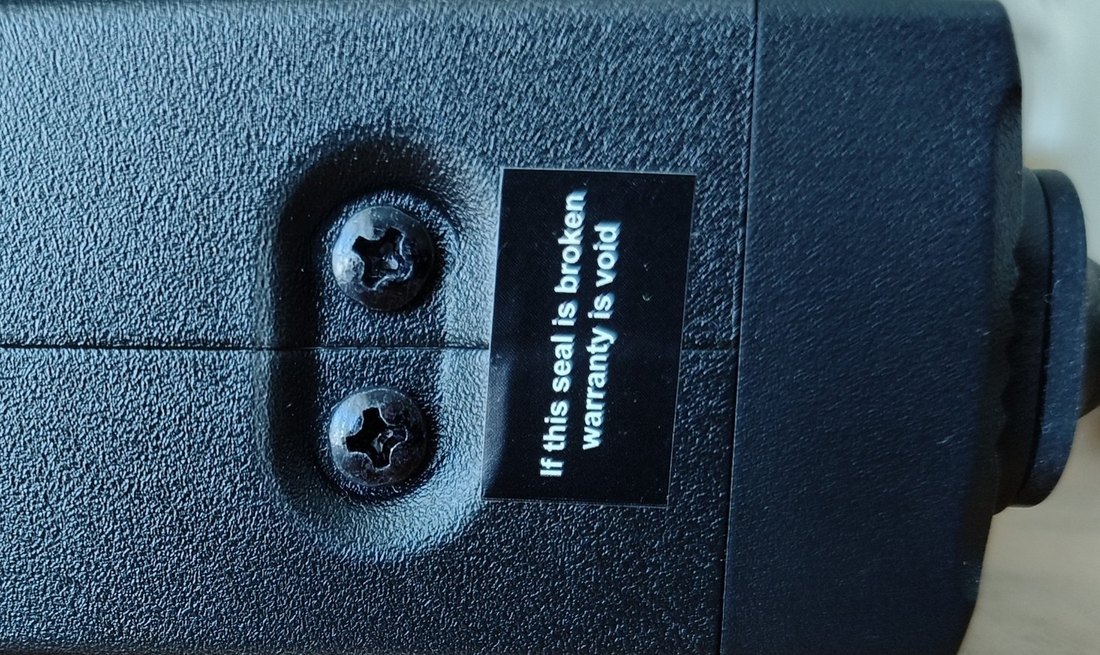
My radio has not been opened or internally adjusted by me since I purchased it. The photograph shows the external seal warning on the casing. This supports my explanation that I have left the radio as supplied, although a photograph of a seal cannot independently establish its entire service history.
For me, the most important point is that a well-installed antenna, suitable coaxial cable and good operating position can matter much more than the 0.97 dB difference between 4 and 5 watts. I still believe that it is reasonable for buyers to expect a radio advertised as 5 watts to be close to that rating under its specified test conditions.
Test equipment
The Nissei RS-502 SWR and power meter
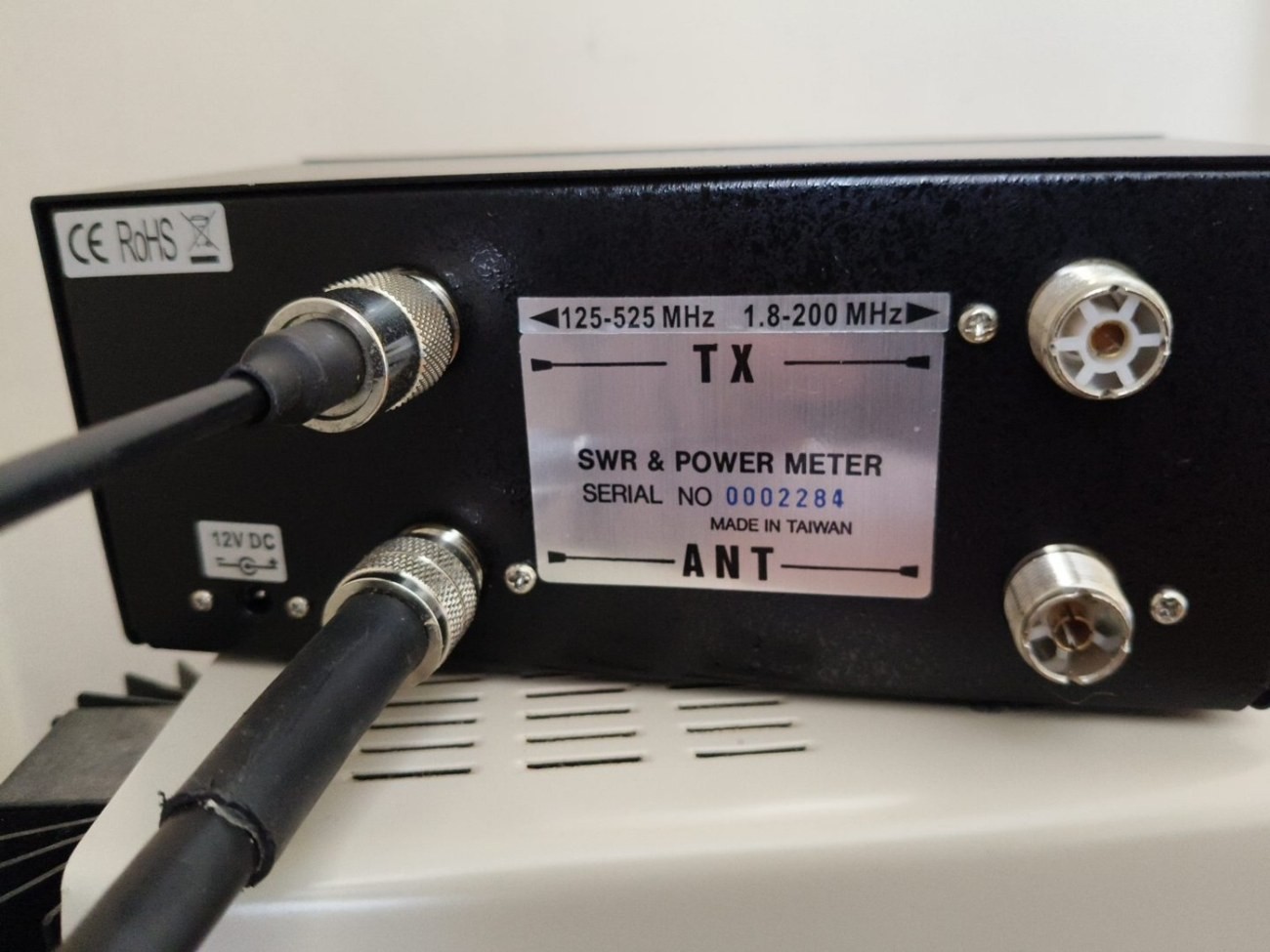
Between my Oricom radio and outdoor antenna, I have installed a Nissei RS-502 SWR and RF power meter. The instrument has two important functions.
Measuring transmitter power
The meter indicates how much radio-frequency power is travelling from the transmitter towards the antenna. My transmitter produces approximately 4 watts according to the meter. The meter is installed before the main 10-metre RG213 antenna cable, so the power reading is taken before the signal experiences most of the attenuation introduced by that cable.
Measuring standing wave ratio
SWR stands for Standing Wave Ratio. It helps determine how well an antenna system is matched to the radio’s transmission line. Most UHF CB radios use a nominal 50-ohm antenna connection. A properly matched antenna helps minimise reflected radio-frequency power. More on SWR is on the Coax & SWR page.