Antenna
My Techoman 6.5 dBi antenna
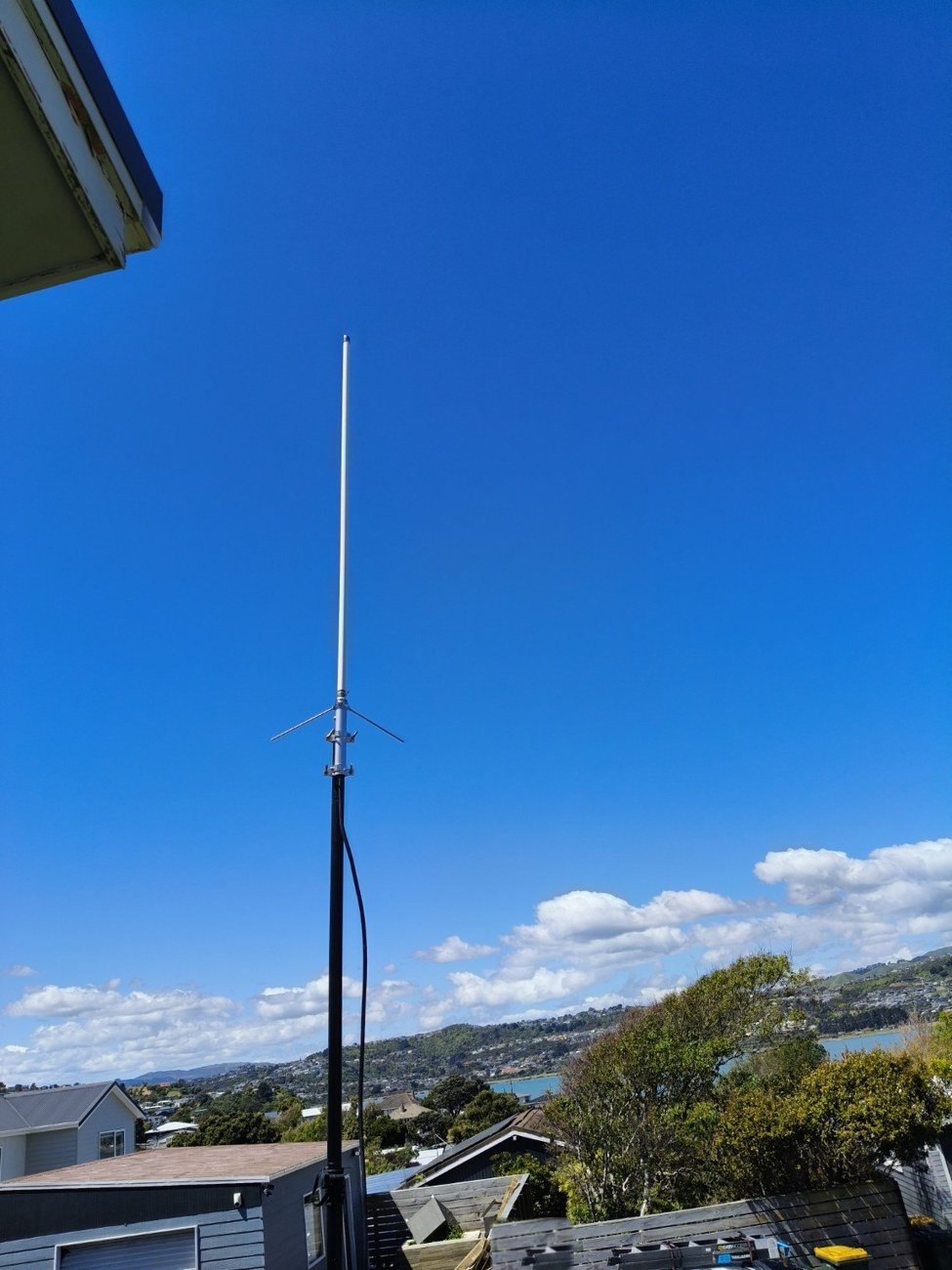
My outdoor antenna is a Techoman vertical UHF antenna with a stated gain of 6.5 dBi. This is one of the most important parts of my installation.
The antenna
Outdoors, on a mast
The antenna is mounted outdoors, above many of the immediate surroundings, to help improve its radio coverage. UHF communication is strongly influenced by antenna position, especially when hills, buildings and vegetation obstruct the path between stations.
A good antenna mounted in a suitable position can provide significantly better results than a poorly positioned antenna, even when both radios transmit at the same power. See Learn: antenna location.
| Item | Details |
|---|---|
| Antenna | Techoman vertical UHF antenna |
| Stated gain | 6.5 dBi |
| Mounting | Outdoors, on a mast |
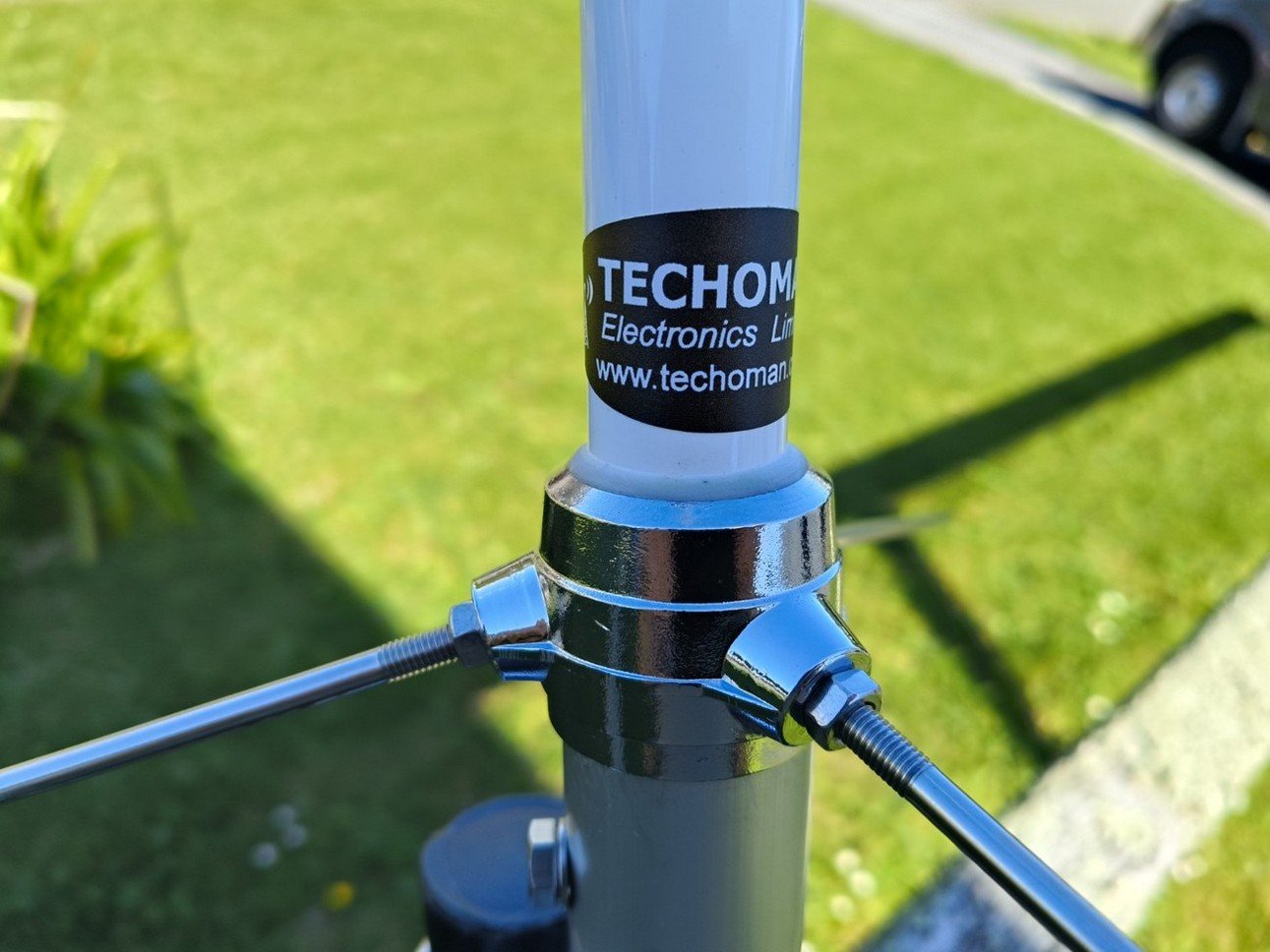
| Radials | Three metal radials at the lower section, extending outwards |
| Polarisation | Vertical, matching the polarisation commonly used for UHF CB |
| Coax | 10 metres of RG213 |
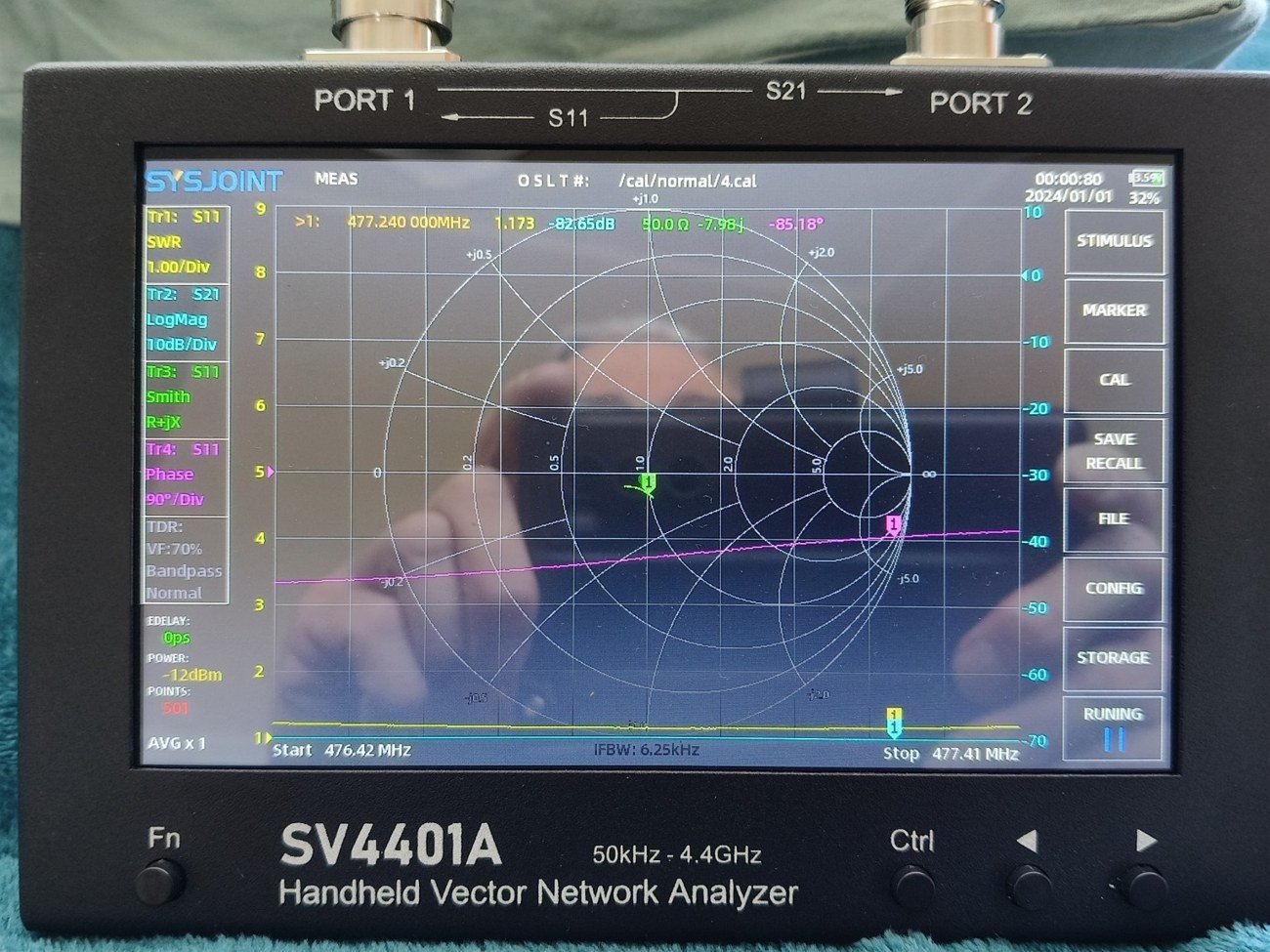
| Measured SWR | 1.17:1 at 477.240 MHz (SV4401A VNA) |
Gain
Understanding antenna gain
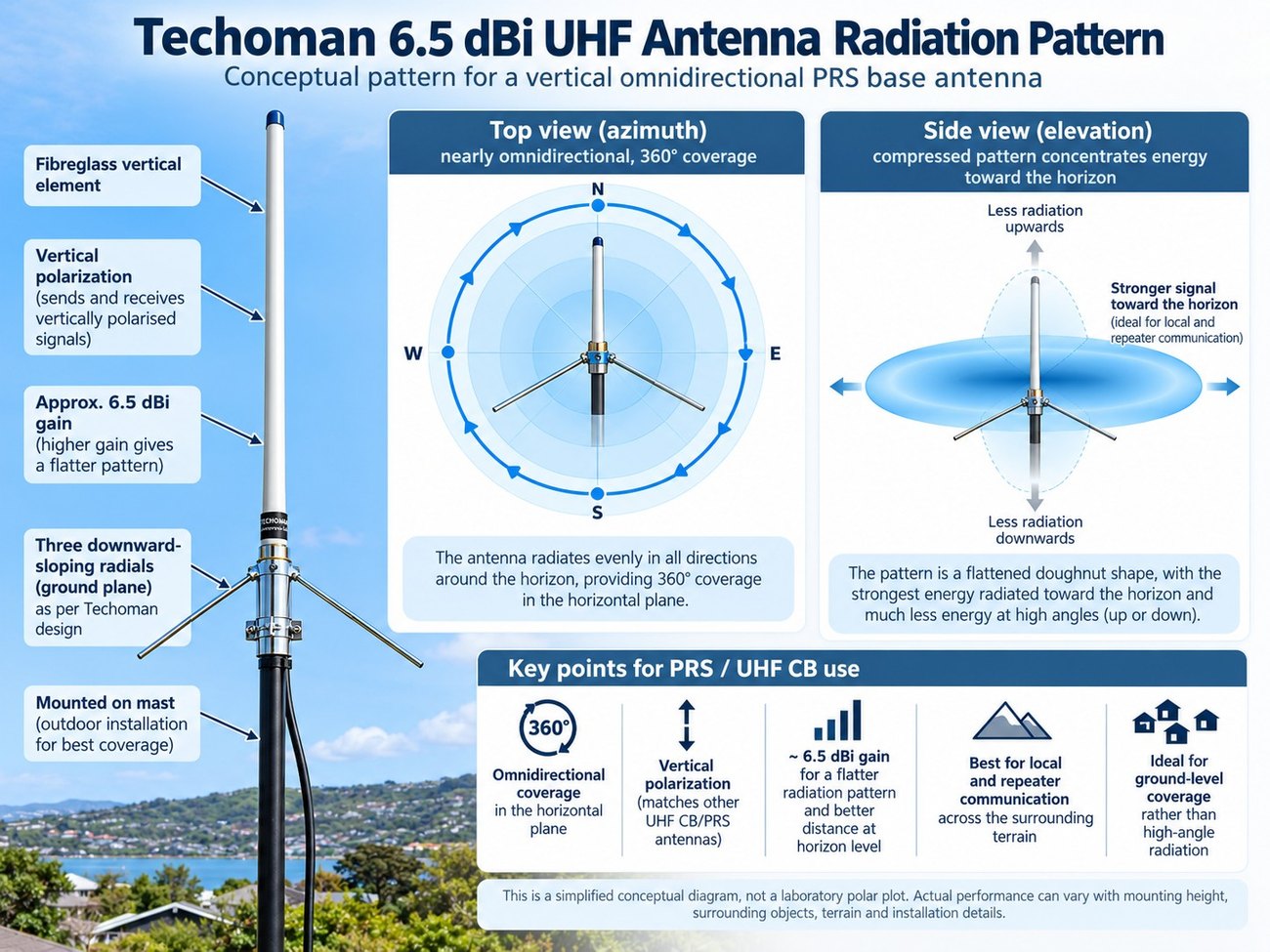
The term dBi describes antenna gain relative to an ideal isotropic radiator, which is a theoretical antenna radiating equally in all directions. My antenna’s stated gain is 6.5 dBi.
This does not mean the antenna produces additional electrical power. Instead, it concentrates the available radio-frequency energy into a particular radiation pattern. A vertically omnidirectional antenna generally concentrates more energy towards the horizon, rather than radiating equally upwards and downwards. This makes it suitable for many types of terrestrial UHF communication. See the Radiation patterns page.
Antenna ground radials
At the lower section of the antenna, three metal radials extend outwards. These form part of the antenna’s design and help establish the intended RF performance.
The antenna is installed vertically, matching the vertical polarisation commonly used for UHF CB communications. Correct polarisation is important because a large mismatch between transmitting and receiving antenna polarisation can cause considerable signal loss.
Measurement
Testing with a vector network analyser
I have tested my antenna using an SV4401A Vector Network Analyzer. A vector network analyzer, commonly abbreviated to VNA, is an instrument used to examine the electrical characteristics of radio-frequency equipment. It can measure antenna impedance, reflection characteristics and standing wave ratio.
| Measurement | Recorded result |
|---|---|
| Frequency | 477.240 MHz |
| SWR | 1.173:1 |
| Return loss | Approximately 22.65 dB |
| Impedance | Close to 50 ohms |
An SWR of 1.173:1 is an excellent impedance-match result. At the measurement reference plane, it corresponds to approximately 0.5–0.6% of the forward power being reflected. This confirms a very good match at the frequency tested.
However, antenna radiation efficiency, surrounding obstructions and the radio path are separate factors that also affect performance. A VNA is particularly useful because it allows an antenna to be checked before relying on it for regular communication.