Reference
The 80-channel PRS guide
A colour-coded reference to every UHF PRS channel: which are repeater pairs, which are for telemetry, and how the 80-channel system came about.
Channel map
80 channels, 476.425–477.4125 MHz
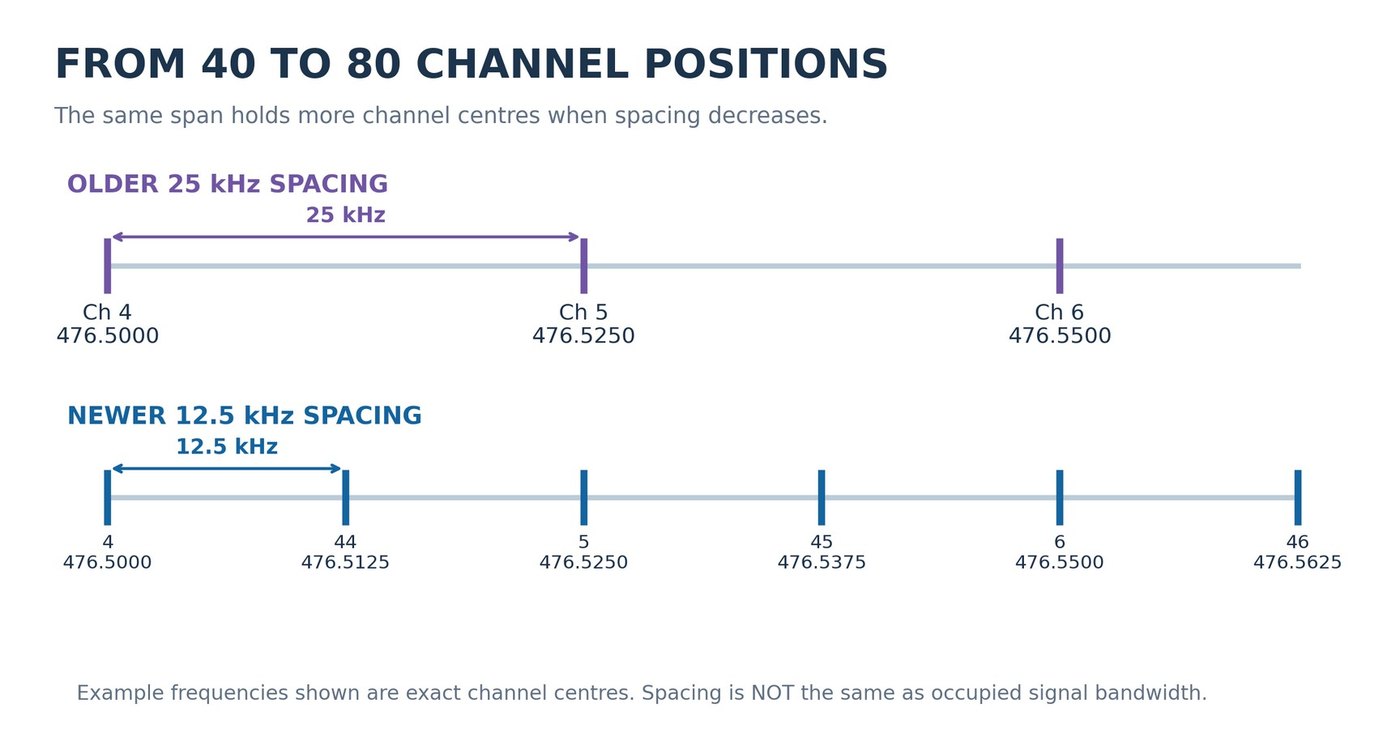
New Zealand UHF PRS has 80 channels between 476.425 MHz and 477.4125 MHz. Channels 1–40 sit on the original 25 kHz centres. Channels 41–80 were slotted in between them on 12.5 kHz centres, so on a frequency axis the order is 1, 41, 2, 42 … 40, 80. Frequencies are the official reference frequencies from the 2011 Citizen Band Radio GURL notice, hosted by Radio Spectrum Management.
By frequency (each slice is one channel)
By channel number
Channel numbers are not ordered by frequency. The label “80-channel” describes channel numbering; five numbered channels (22, 23, 61, 62 and 63) are not normal voice channels. Repeater inputs should not be used for ordinary simplex where that would interfere with repeaters.
Repeater pairs
Outputs and inputs
Repeater outputs are Channels 1–8 and 41–48. The corresponding inputs are Channels 31–38 and 71–78: each input is 30 channels above its output, and the frequency split is 750 kHz. Channel 5 (output) pairs with Channel 35 (input), the pair used by Mt Climie.
| Repeater output | Output MHz | Repeater input | Input MHz | Split |
|---|---|---|---|---|
| Ch 1 | 476.4250 | Ch 31 | 477.1750 | 750 kHz |
| Ch 2 | 476.4500 | Ch 32 | 477.2000 | 750 kHz |
| Ch 3 | 476.4750 | Ch 33 | 477.2250 | 750 kHz |
| Ch 4 | 476.5000 | Ch 34 | 477.2500 | 750 kHz |
| Ch 5 | 476.5250 | Ch 35 | 477.2750 | 750 kHz |
| Ch 6 | 476.5500 | Ch 36 | 477.3000 | 750 kHz |
| Ch 7 | 476.5750 | Ch 37 | 477.3250 | 750 kHz |
| Ch 8 | 476.6000 | Ch 38 | 477.3500 | 750 kHz |
| Ch 41 | 476.4375 | Ch 71 | 477.1875 | 750 kHz |
| Ch 42 | 476.4625 | Ch 72 | 477.2125 | 750 kHz |
| Ch 43 | 476.4875 | Ch 73 | 477.2375 | 750 kHz |
| Ch 44 | 476.5125 | Ch 74 | 477.2625 | 750 kHz |
| Ch 45 | 476.5375 | Ch 75 | 477.2875 | 750 kHz |
| Ch 46 | 476.5625 | Ch 76 | 477.3125 | 750 kHz |
| Ch 47 | 476.5875 | Ch 77 | 477.3375 | 750 kHz |
| Ch 48 | 476.6125 | Ch 78 | 477.3625 | 750 kHz |
Channel table
Find a channel
80 of 80 channels
| Channel | MHz | Category | Pair | Notes |
|---|---|---|---|---|
| 1 | 476.4250 | Repeater output | ↔ Ch 31 | |
| 2 | 476.4500 | Repeater output | ↔ Ch 32 | |
| 3 | 476.4750 | Repeater output | ↔ Ch 33 | |
| 4 | 476.5000 | Repeater output | ↔ Ch 34 | |
| 5 | 476.5250 | Repeater output | ↔ Ch 35 | Mt Climie repeater output (what you hear). My station. |
| 6 | 476.5500 | Repeater output | ↔ Ch 36 | |
| 7 | 476.5750 | Repeater output | ↔ Ch 37 | |
| 8 | 476.6000 | Repeater output | ↔ Ch 38 | |
| 9 | 476.6250 | Simplex | – | |
| 10 | 476.6500 | Simplex | – | |
| 11 | 476.6750 | Simplex | – | Simplex. NZ has no official calling channel; Ch 11 is commonly used as one by convention. |
| 12 | 476.7000 | Simplex | – | |
| 13 | 476.7250 | Simplex | – | Local simplex. My station. |
| 14 | 476.7500 | Simplex | – | |
| 15 | 476.7750 | Simplex | – | |
| 16 | 476.8000 | Simplex | – | |
| 17 | 476.8250 | Simplex | – | |
| 18 | 476.8500 | Simplex | – | |
| 19 | 476.8750 | Simplex | – | |
| 20 | 476.9000 | Simplex | – | |
| 21 | 476.9250 | Simplex | – | |
| 22 | 476.9500 | Telemetry only | – | Telemetry and telecommand only (no voice). |
| 23 | 476.9750 | Telemetry only | – | Telemetry and telecommand only (no voice). |
| 24 | 477.0000 | Simplex | – | |
| 25 | 477.0250 | Simplex | – | |
| 26 | 477.0500 | Simplex | – | |
| 27 | 477.0750 | Simplex | – | |
| 28 | 477.1000 | Simplex | – | |
| 29 | 477.1250 | Simplex | – | |
| 30 | 477.1500 | Simplex | – | |
| 31 | 477.1750 | Repeater input | ↔ Ch 1 | |
| 32 | 477.2000 | Repeater input | ↔ Ch 2 | |
| 33 | 477.2250 | Repeater input | ↔ Ch 3 | |
| 34 | 477.2500 | Repeater input | ↔ Ch 4 | |
| 35 | 477.2750 | Repeater input | ↔ Ch 5 | Mt Climie repeater input (what you transmit). My station. |
| 36 | 477.3000 | Repeater input | ↔ Ch 6 | |
| 37 | 477.3250 | Repeater input | ↔ Ch 7 | |
| 38 | 477.3500 | Repeater input | ↔ Ch 8 | |
| 39 | 477.3750 | Simplex | – | |
| 40 | 477.4000 | Simplex | – | |
| 41 | 476.4375 | Repeater output | ↔ Ch 71 | |
| 42 | 476.4625 | Repeater output | ↔ Ch 72 | |
| 43 | 476.4875 | Repeater output | ↔ Ch 73 | |
| 44 | 476.5125 | Repeater output | ↔ Ch 74 | |
| 45 | 476.5375 | Repeater output | ↔ Ch 75 | |
| 46 | 476.5625 | Repeater output | ↔ Ch 76 | |
| 47 | 476.5875 | Repeater output | ↔ Ch 77 | |
| 48 | 476.6125 | Repeater output | ↔ Ch 78 | |
| 49 | 476.6375 | Simplex | – | |
| 50 | 476.6625 | Simplex | – | |
| 51 | 476.6875 | Simplex | – | |
| 52 | 476.7125 | Simplex | – | |
| 53 | 476.7375 | Simplex | – | |
| 54 | 476.7625 | Simplex | – | |
| 55 | 476.7875 | Simplex | – | |
| 56 | 476.8125 | Simplex | – | |
| 57 | 476.8375 | Simplex | – | |
| 58 | 476.8625 | Simplex | – | |
| 59 | 476.8875 | Simplex | – | |
| 60 | 476.9125 | Simplex | – | |
| 61 | 476.9375 | Leave clear | – | Leave clear (community guidance). |
| 62 | 476.9625 | Leave clear | – | Leave clear (community guidance). |
| 63 | 476.9875 | Leave clear | – | Leave clear (community guidance). |
| 64 | 477.0125 | Simplex | – | |
| 65 | 477.0375 | Simplex | – | |
| 66 | 477.0625 | Simplex | – | |
| 67 | 477.0875 | Simplex | – | |
| 68 | 477.1125 | Simplex | – | |
| 69 | 477.1375 | Simplex | – | |
| 70 | 477.1625 | Simplex | – | |
| 71 | 477.1875 | Repeater input | ↔ Ch 41 | |
| 72 | 477.2125 | Repeater input | ↔ Ch 42 | |
| 73 | 477.2375 | Repeater input | ↔ Ch 43 | |
| 74 | 477.2625 | Repeater input | ↔ Ch 44 | |
| 75 | 477.2875 | Repeater input | ↔ Ch 45 | |
| 76 | 477.3125 | Repeater input | ↔ Ch 46 | |
| 77 | 477.3375 | Repeater input | ↔ Ch 47 | |
| 78 | 477.3625 | Repeater input | ↔ Ch 48 | |
| 79 | 477.3875 | Simplex | – | |
| 80 | 477.4125 | Simplex | – |
Source: Radiocommunications Regulations (General User Radio Licence for Citizen Band Radio) Notice 2011, official PDF hosted by RSM. The RadioWiki UHF PRS frequency list was used only as a community cross-check. See Links.
Emergency
No official emergency channel
New Zealand does not designate any PRS channel as an emergency channel. Channels 5 and 35 are a repeater output and input, not a reserved distress pair. The official GURL notice does not set any PRS channel aside for emergencies. The “Channel 5 / 35 emergency only” arrangement is an Australian one, not a New Zealand one. Check local rules and do not assume Australian channel-use conventions apply here.
If you need help, do not assume a particular channel is being monitored. Repeater availability is not guaranteed, and UHF CB should not be treated as a substitute for dedicated emergency communications.
Channels 22, 23 and 61–63
Channels 22 and 23 are not voice channels at all: the official notice limits them to telemetry and telecommand. Community guidance is to leave Channels 61, 62 and 63 clear as well, because they sit against those wider data channels. The official notice does not itself label 61–63 as reserved.
History
How 40 channels became 80
Older 40-channel radios only have Channels 1–40, spaced 25 kHz apart. In 2011 the official GURL notice added Channels 41–80 in the gaps, each 12.5 kHz wide. An 80-channel radio (like the Oricom at this station) can use the whole plan.
On Channels 1–40, both 25 kHz wideband and 12.5 kHz narrowband emissions are permitted. Channels 41–80 are narrowband only. A 40-channel radio and an 80-channel radio can usually still talk on 1–40, but a wideband signal may sound louder or a little rougher to a narrowband receiver, and a narrowband signal may sound quieter to a wideband radio.
Bandwidth
12.5 kHz narrowband vs 25 kHz wideband
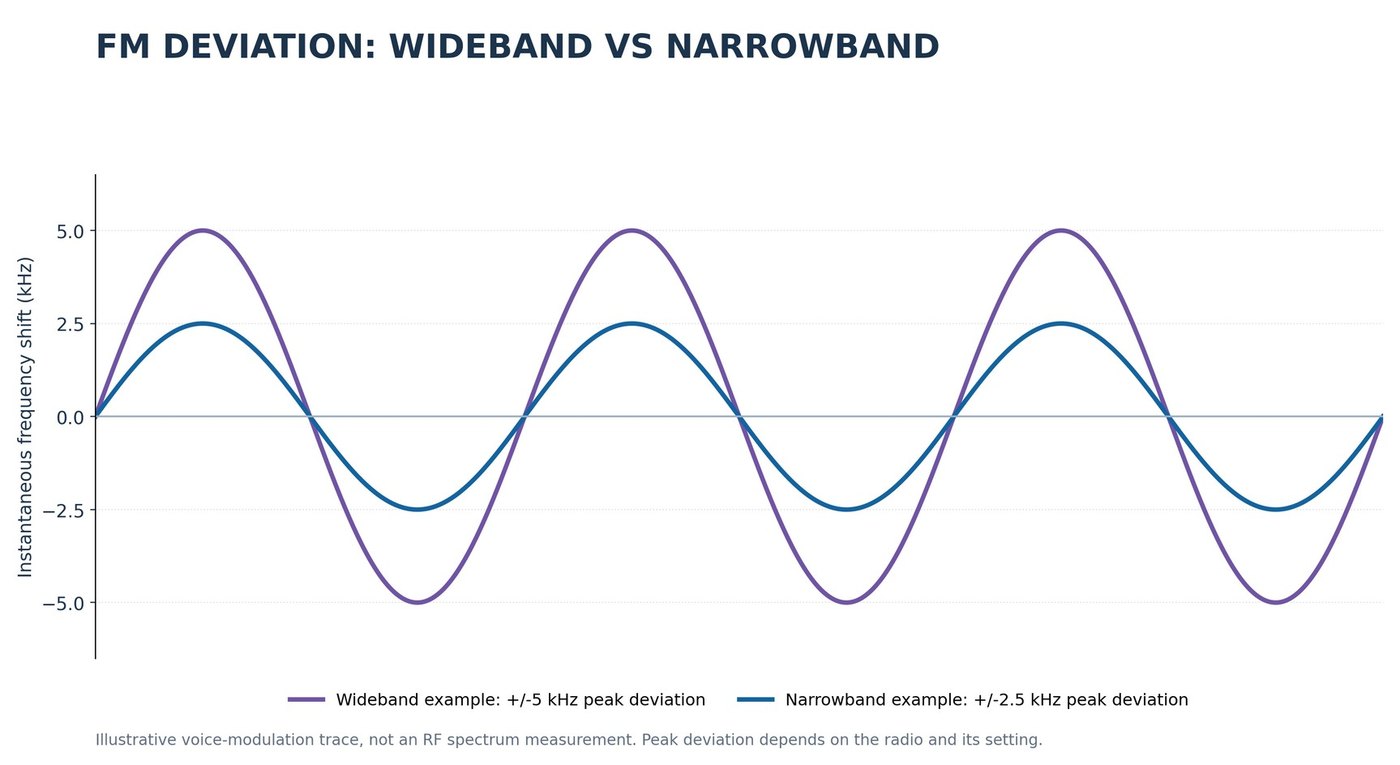
In analogue FM, your voice makes the transmitter frequency move slightly above and below its centre frequency. For typical 25 kHz wideband speech systems, peak deviation is around ±5 kHz. For typical 12.5 kHz narrowband speech systems, it is around ±2.5 kHz. Radios also use filtering matched to their channel format.
| Feature | Older wideband example | Modern narrowband example |
|---|---|---|
| Channel spacing | 25 kHz | 12.5 kHz |
| Typical maximum FM deviation | ±5 kHz | ±2.5 kHz |
| General result | Wider transmitted signal | Narrower transmitted signal |
| Suitable reception | Wideband receiver | Narrowband receiver |
A narrowband radio heard on a wideband receiver can sound quiet. A wideband transmission heard on a narrowband receiver can sound very loud, distorted or clipped and may cause adjacent-channel interference. These are potential effects, not an automatic failure of every mixed-bandwidth contact.
Narrowband does not automatically mean shorter range. Antenna height, receiver sensitivity, noise, terrain and the radio path remain major factors.
Channel spacing is the distance between assigned channel centres. It is not itself a measurement of actual transmitted RF bandwidth. The amount of occupied bandwidth also depends on FM deviation, audio spectrum and transmitter design.